- This event has passed.
Book Club: The Great River: The Making and Unmaking of the Mississippi
NOMA’s book club meets monthly to discuss fiction and non-fiction books related to art in the museum’s collection and exhibitions.
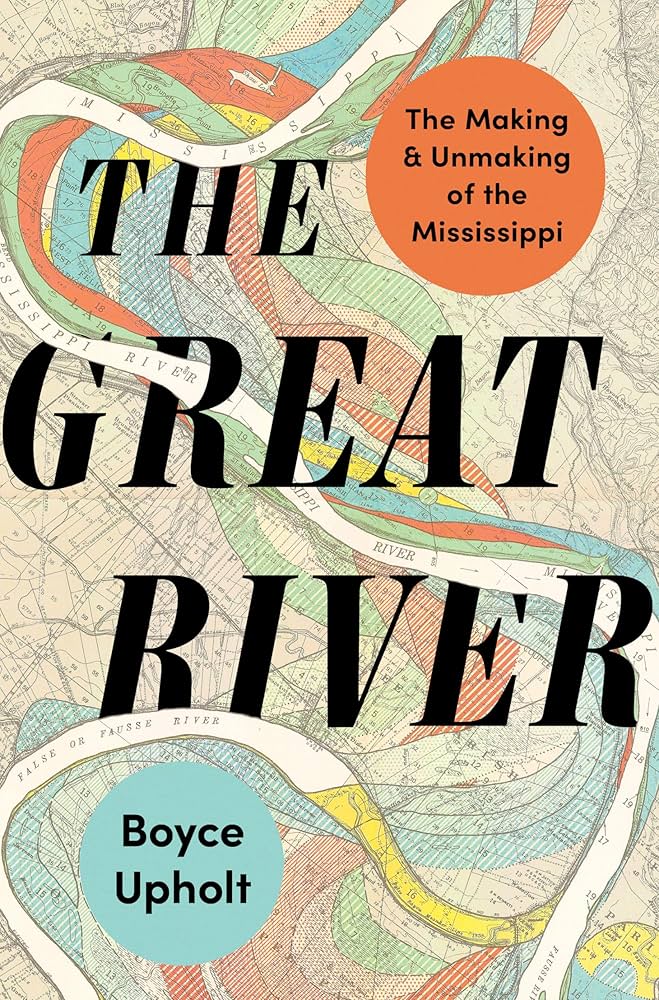
This month’s book club selection is The Great River: The Making and Unmaking of the Mississippi by Boyce Upholt, a landmark work of natural history in which Upholt tells the epic story of the wild and unruly Mississippi River and the centuries spent attempting to control it.
This month’s book club will also be paired with two gallery talks where Upholt will connect his work in The Great River with the works on view in the exhibition Nicolas Floc’h: Fleuves-Océan, Mississippi Watershed and sign copies of The Great River for attendees.
View Upholt Gallery Talk and Book Signing Events
About NOMA’s Book Club
NOMA’s book club is an informal group open to anyone on a month-to-month basis. You do not have to attend every meeting or read every book to participate. In addition to monthly book discussions, the book club meets periodically for curatorial programs related to the book selections.
Books are selected in advance and planned according to the museum’s exhibition schedule. Participants are expected to procure their own copy of the titles. Selections are also available at the NOMA Museum Shop, where museum members receive a 10% discount.
Meetings are held in person or via Zoom. All meetings begin at 12 pm. For more information or questions, please email programs@noma.org.
About the Book
The Great River: The Making and Unmaking of the Mississippi
Winner of the 2024 Willie Morris Award for Southern Nonfiction • A Chicago Public Library Must-Read Book of 2024 • A Booklist Editors’ Choice
The Mississippi River lies at the heart of America, an undeniable life force that is intertwined with the nation’s culture and history. Its watershed spans almost half the country, Mark Twain’s travels on the river inspired our first national literature, and jazz and blues were born in its floodplains and carried upstream.
In this landmark work of natural history, Boyce Upholt tells the epic story of this wild and unruly river, and the centuries of efforts to control it. Over thousands of years, the Mississippi watershed was home to millions of Indigenous people who regarded “the great river” with awe and respect, adorning its banks with astonishing spiritual earthworks. The river was ever-changing, and Indigenous tribes embraced and even depended on its regular flooding. But the expanse of the watershed and the rich soils of its floodplain lured European settlers and American pioneers, who had a different vision: the river was a foe to conquer.
Centuries of human attempts to own, contain, and rework the Mississippi River, from Thomas Jefferson’s expansionist land hunger through today’s era of environmental concern, have now transformed its landscape. Upholt reveals how an ambitious and sometimes contentious program of engineering—government-built levees, jetties, dikes, and dams—has not only damaged once-vibrant ecosystems but may not work much longer. Carrying readers along the river’s last remaining backchannels, he explores how scientists are now hoping to restore what has been lost.
Rich and powerful, The Great River delivers a startling account of what happens when we try to fight against nature instead of acknowledging and embracing its power—a lesson that is all too relevant in our rapidly changing world.
-description from W.W. Norton & Company
About Boyce Upholt